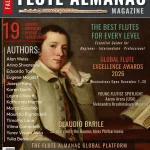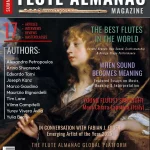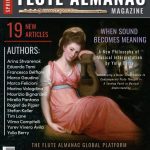
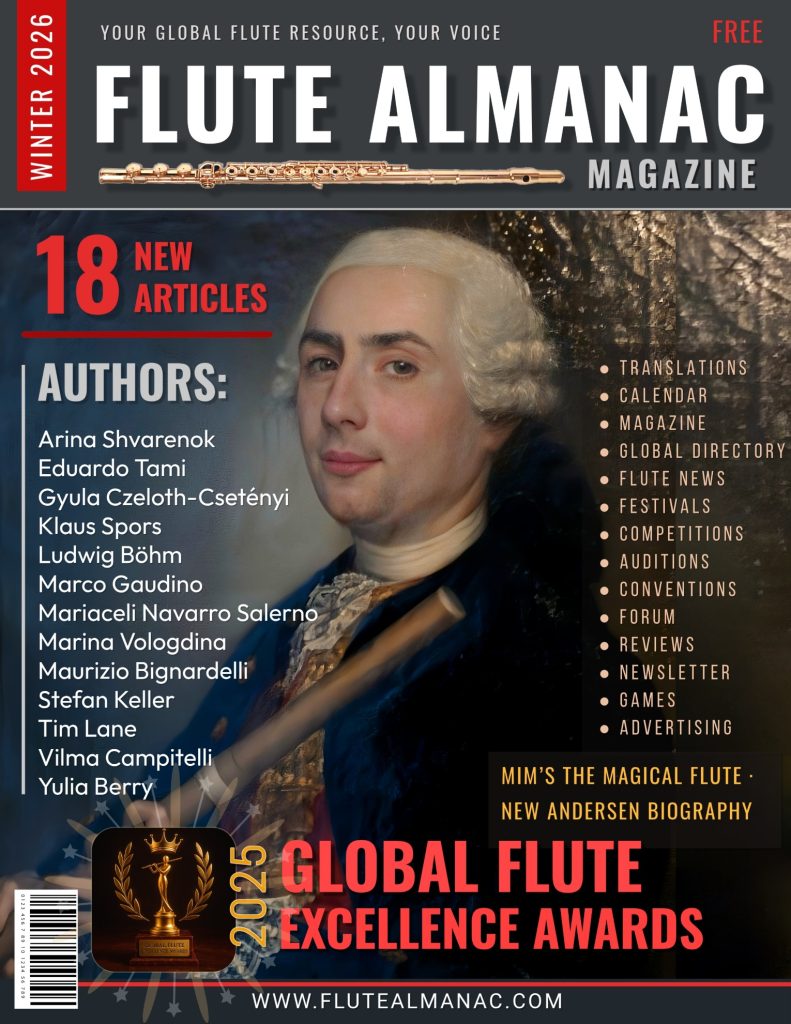
The Winter 2026 edition of Flute Almanac brought together 18 in-depth articles by 13 authors from eight countries, creating one of the publication’s most wide-ranging explorations of flute history, performance, pedagogy, science, cultural memory, and artistic thought.
Its contributors represented the United States, Russia, Italy, Germany, Argentina, Hungary, Venezuela, and Switzerland. Their work moved between centuries and disciplines: from prehistoric instruments and nineteenth-century virtuosi to contemporary cognition, physiological research, repertoire discovery, interpretation, teaching, and the ethical responsibilities of musicians.
Together, these articles presented the flute not merely as a musical instrument, but as a living continuum of craftsmanship, knowledge, imagination, education, identity, and human expression.
Why Documenting Flute History Is an Act of Cultural Preservation
This foundational essay examines documentation as an act of cultural stewardship. It considers how performers, teachers, makers, institutions, artistic lineages, pedagogical traditions, and instrument-making knowledge can disappear when they are not intentionally recorded. The article also places the Global Flute Excellence Awards within a larger mission of historical preservation, arguing that recognition becomes meaningful when it is supported by context, memory, and international inclusion.
The Magical Flute: A Global Journey Through 8,000 Years of Sound and Story
Inspired by the landmark exhibition at the Musical Instrument Museum in Phoenix, this sweeping historical feature follows the flute across eight millennia of human civilization. It explores prehistoric bone flutes, ritual instruments, court traditions, craftsmanship, mythology, symbolism, identity, and modern performance. Instruments associated with major historical and contemporary figures appear within a much larger story of breath, sound, power, beauty, and imagination across cultures.
The Transformation of Musical Consciousness: What Digitalization Takes from—and Gives to—the Classical Musician
Arina Shvarenok investigates how digital tools are changing the cognitive foundations of classical musicianship. Moving beyond convenience, she considers the effects of screens, scrolling scores, digital annotation, tuners, and metronomes on spatial memory, tactile perception, attention, intuition, and inner hearing. Rather than rejecting technology, the essay proposes a consciously balanced musical intelligence in which digital analysis and embodied listening can coexist.
Trabajando sobre “Café 1930” — Part 3
In the third installment of his study of Piazzolla’s Café 1930, Eduardo Tami explores the interpretive decisions that transform notation into tango. He discusses rubato, ornamentation, glissandi, rhythmic flexibility, tonal inflection, phrasing, and the transition from melancholy toward luminosity. The article encourages informed freedom rather than mechanical adherence to the score and concludes with practical ideas for shaping the final section.
A New Lens on Old Flutes: Rediscovering 19th-Century Secrets with Anne Pustlauk
This extensive interview enters the world of historical flutist and scholar Anne Pustlauk. It traces her path from the modern Boehm flute to simple-system instruments and examines the technical, stylistic, and expressive demands of nineteenth-century performance. Her research on Jean-Louis Tulou, conservatoire traditions, original instruments, and forgotten repertoire reveals how historical knowledge can transform both interpretation and pedagogy.
More Than a Flutist: Thomas Nyfenger (1936–1990)
Klaus Spors restores attention to Thomas Nyfenger as a performer, teacher, thinker, and author of Music and the Flute. Blending biography, reflection, and an imagined interview constructed from Nyfenger’s own words, the article illuminates his ideas about listening, individuality, humor, musical context, and personal sound. It also treats the complexity of his life with sensitivity, including his struggle with depression.
Boehm’s Legacy in the Balkans: Ludwig Böhm’s 2025 Lecture Tour
Ludwig Böhm documents his journey through Sarajevo, Podgorica, Cetinje, Pristina, Skopje, and Tirana, where he shared the history and continuing influence of Theobald Böhm. Written as a firsthand travel chronicle, the article records lectures, concerts, institutional encounters, difficult journeys, and the enthusiasm of students and musicians throughout Southeastern Europe. It is both a personal account and a document of living flute history.
Breathing in Sound Production — Part I: Physical Breathing
Marco Gaudino approaches breathing as an aerodynamic and physiological process rather than a simple muscular action. The article examines pressure, airflow, temperature, condensation, rarefaction, the lungs, oral cavity, vocal tract, and the behavior of respiratory structures during instrumental performance. Connecting physics, physiology, acoustics, pedagogy, and expression, it offers a research-based foundation for understanding breath as the generator of sound.
More Than 100 Works for Piccolo Written by Women
This large-scale repertoire survey documents more than one hundred piccolo works by women composers. The catalogue spans solo music, chamber works, mixed ensembles, electronics, concertos, orchestral writing, and pedagogical repertoire. Conceived as a living document, it provides performers, teachers, programmers, and researchers with a practical resource while addressing the historical invisibility of women’s contributions to the piccolo literature.
The Art of Intonation: How to Develop Pure Pitch and a Deep Tone — Part III
Marina Vologdina examines intonation and tone as inseparable parts of healthy flute technique. Her practical discussion includes long tones, octaves, intervals, resonators, dynamics, vibrato, ensemble playing, posture, embouchure, breathing, and the development of a clear inner sound image. The article presents pitch not as a mechanical correction, but as a holistic process involving the body, ear, imagination, and musical intention.
Luigi Marini: An Aristocratic Virtuoso of the Italian Flute School
Maurizio Bignardelli restores Count Luigi Marini to the history of nineteenth-century Italian flute playing. Admired by figures including Giulio Briccialdi, Cesare Ciardi, Giuseppe Rabboni, and Emanuele Krakamp, Marini occupied an unusual position between aristocratic culture, virtuosity, scholarship, and private music-making. The article explores his repertoire, his association with the Ziegler-system flute, and his brilliant operatic paraphrases.
The Magic of the Flute — FLAUTANDO Boswil 2026
Stefan Keller introduces the immersive FLAUTANDO Boswil surround concert, staged in the historic Boswil concert church. Featuring the complete flute family from piccolo to subcontrabass, the program combines Romantic repertoire, contemporary works, improvisation, jazz influence, spatial sound, and unusual instrumental colors. The audience is placed at the center of an experience that dissolves the boundary between concert, environment, and sonic exploration.
My Studies with Maurice Sharp: Lessons from an American Original
Timothy Lane offers a deeply personal memoir of studying with Maurice Sharp, longtime principal flute of The Cleveland Orchestra under George Szell. Through vivid recollections and technical observations, Lane preserves Sharp’s ideas about sound, rhythm, intonation, responsibility, discipline, and musical lineage. The essay becomes an important oral history of the American flute school and of values transmitted directly from teacher to student.
Graciela Agudelo Murguía (1945–2018): A Free Voice from Mexico
Vilma Campitelli presents Graciela Agudelo Murguía as a composer, educator, cultural advocate, and independent thinker whose work joined experimentation with indigenous memory and social consciousness. The article examines Agudelo’s compositional language, educational work, international leadership, reflections on gender and silence, and her flute repertoire, including Seis Meditaciones sobre Abya Yala.
When the Ego Outplays the Music: Navigating Egocentrism in the Musical World
Yulia Berry considers how ambition, competition, conservatoire culture, and digital self-promotion can gradually shift attention away from music itself. The essay does not reject individuality or achievement, but asks how confidence can remain balanced by listening, humility, mentorship, curiosity, collaboration, and generosity. It argues that enduring artistry is created through dialogue, not through self-presentation alone.
Leonardo da Vinci’s To-Do List: Lessons for Flutists
Using Leonardo da Vinci’s notebooks as a point of departure, Yulia Berry contrasts routine practice with a broader culture of inquiry. She invites flutists to learn from science, art, movement, history, nature, architecture, and observation rather than confining musical development to exercises and repertoire. Curiosity becomes not an optional quality, but one of the central engines of artistic growth.
Inside “The Magical Flute” Exhibition at MIM: A Curator’s Perspective on Beauty, Enchantment, and Power
In this exclusive interview, Yulia Berry speaks with Eddie Chia-Hao Hsu, curator for Asia and Oceania at the Musical Instrument Museum and a professional flutist. Their conversation reveals how the exhibition was researched, organized, and interpreted across continents and centuries. The discussion includes ancient instruments, ceremonial objects, Boehm’s innovations, iconic modern flutes, performance traditions, symbolism, and the challenge of presenting instruments as living cultural narratives.
The Joachim Andersen We Never Knew: A Brilliant New Biography
This review examines the major biography by Kyle Dzapo, András Adorján, and William Wilsen, published by Oxford University Press in 2025. The book restores Joachim Andersen as far more than the composer of familiar études: he emerges as a virtuoso, conductor, founding member of the Berlin Philharmonic, and central figure in Danish musical culture. The review also highlights the volume’s visual documentation, readability, catalogue of works, and important reassessment of Andersen’s pedagogical music.
A Global Portrait of the Flute
The Winter 2026 edition connected historical recovery, contemporary research, performance practice, pedagogy, cultural preservation, and philosophical reflection. Each contribution added a different voice to a shared understanding of the flute as an instrument shaped by centuries of human curiosity and creative work.
The complete edition remains available through Flute Almanac, where every article can be read in full.
Explore the Complete Flute Almanac Ecosystem
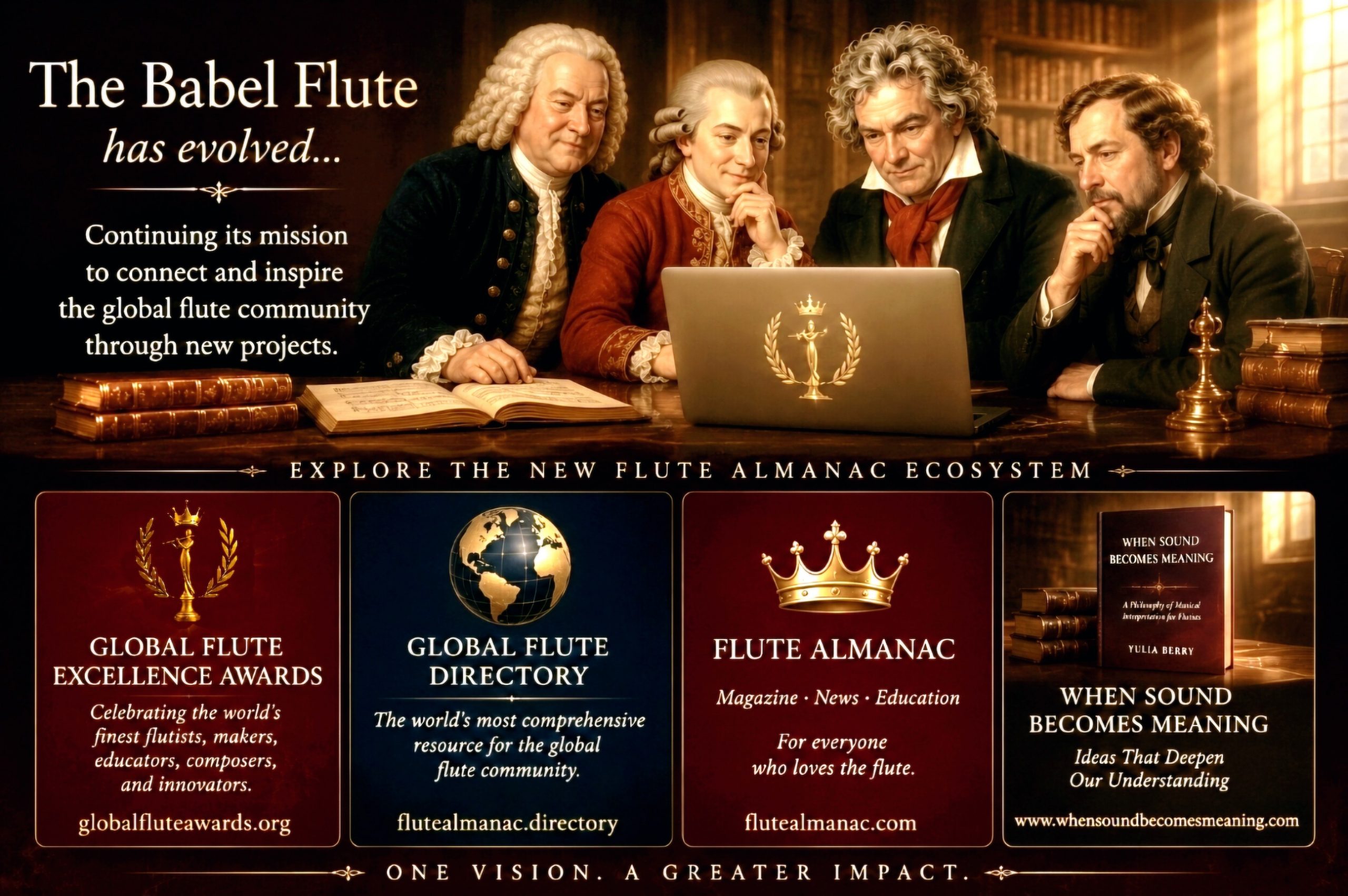
Flute Almanac has grown into an interconnected international ecosystem devoted to flute performance, education, history, research, craftsmanship, cultural preservation, professional visibility, artistic excellence, and meaningful thought.
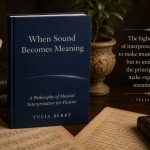
Explore the magazine, discover the worldwide flute community through the Global Flute Directory, learn about the Global Flute Excellence Awards, follow important events and dates, and continue into the philosophical world of Toward Meaning and When Sound Becomes Meaning.
Together, these projects preserve flute heritage, support international visibility, recognize exceptional contributions, and create new connections between music, education, history, culture, beauty, and meaning.