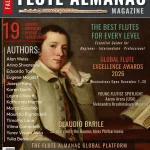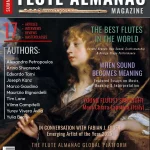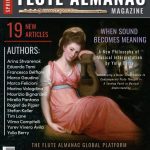
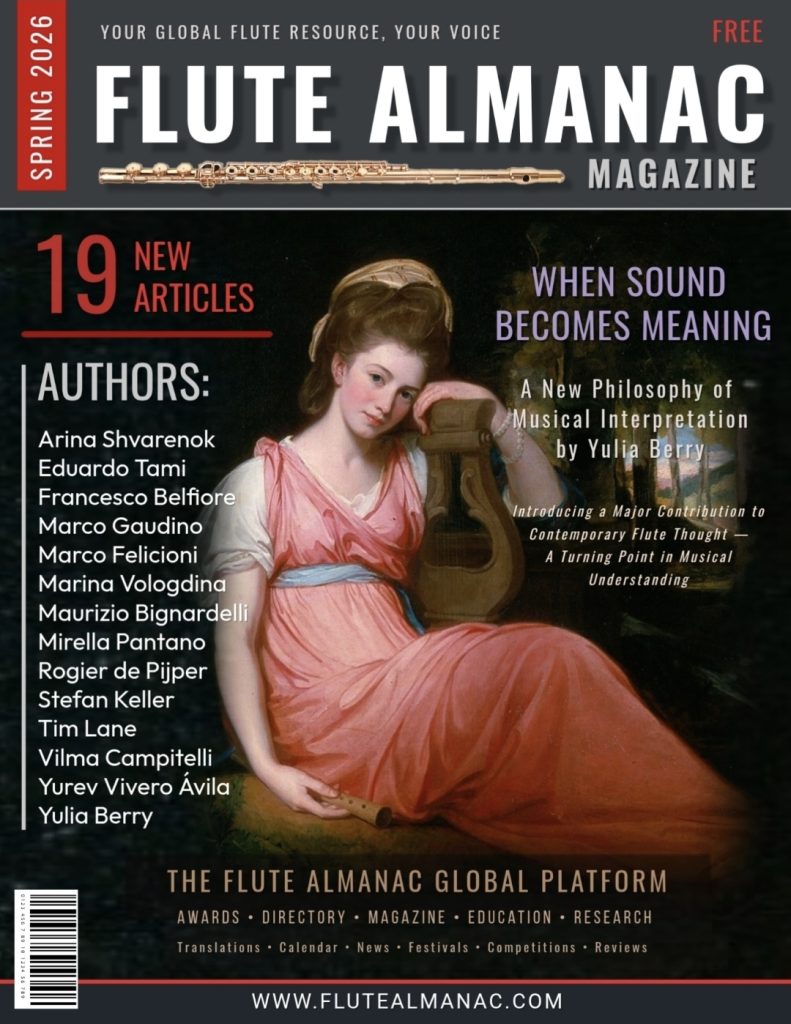
The Spring 2026 edition of Flute Almanac, originally published on March 15, 2026, presents one of the magazine’s most diverse and thought-provoking collections to date. Featuring 19 articles by 14 authors from 7 countries, this issue explores the many dimensions of flute artistry through historical scholarship, pedagogy, scientific research, professional reflection, contemporary performance, and philosophical inquiry.
A defining highlight of this edition is the introduction of Young Flutist Spotlight, a new international initiative created to celebrate talented pre-college flutists and the teachers who inspire their musical development. Rather than functioning as a competition, the program recognizes dedication, artistic growth, and emerging talent while building a lasting international archive of the next generation of flute artists.
The edition also examines many of the questions facing musicians today. Readers will discover reflections on professional life, the mental challenges of the digital age, and thoughtful discussions about the value of artistic work in contemporary society. Historical research remains a central pillar of the issue, with studies devoted to Donato Lovreglio, Ursula Mamlok, Jacques-Martin Hotteterre, André Jolivet, and the fascinating piffero tradition of Italy’s Apennine region.
Pedagogical and scientific topics receive equal attention throughout the edition. Contributors examine breathing physiology, articulation habits such as anchor tonguing, expressive performance, modern piccolo pedagogy, and new approaches to sound production. Together, these articles reaffirm Flute Almanac’s commitment to documenting, preserving, and celebrating the rich diversity of flute culture around the world.
Young Flutist Spotlight: Celebrating the Next Generation of Flute Artists
By Flute Almanac
The Spring 2026 edition marks the launch of Young Flutist Spotlight, a new international initiative dedicated to recognizing talented pre-college flutists and the teachers who nurture their artistic development. Rather than functioning as a competition, the program celebrates dedication, curiosity, perseverance, and musical growth while providing young musicians with meaningful international visibility.
Beginning in April 2026, selected students from around the world are invited to share their biographies, achievements, artistic goals, and performance recordings with the global flute community. Each feature serves not only as a recognition of individual accomplishment, but also as encouragement for continued artistic development at a formative stage of a musician’s life.
By highlighting both students and their mentors, Young Flutist Spotlight also acknowledges the essential role of dedicated teachers in shaping future generations of performers. Over time, the initiative aims to create a lasting international archive documenting emerging flute talent and celebrating excellence through inspiration rather than competition.
Fine Tuning: The Musician’s Mind in the Digital Age — Part I: Cognitive Overload
By Arina Shvarenok · Russia
Opening a new research series devoted to musicians’ mental well-being, Arina Shvarenok examines one of the defining challenges of contemporary artistic life: cognitive overload. As digital technologies increasingly shape professional music careers, performers are expected to balance artistic preparation with constant communication, online visibility, administrative work, and social-media engagement.
Drawing on cognitive psychology as well as her observations within the professional music community, Shvarenok explains how continuous digital stimulation affects concentration, emotional energy, decision-making, and the capacity for deep artistic focus. The article encourages musicians to recognize these hidden pressures and cultivate healthier relationships with technology while preserving the reflective state necessary for meaningful musical interpretation.
This first installment establishes the foundation for a broader series exploring subjects such as digital perfectionism, impostor syndrome, artistic identity, and the changing psychological landscape of professional musicianship in the twenty-first century.
The Reality of Being a Professional Flutist: Challenges, Adaptation, and the Search for One’s Own Voice
By Eduardo Tami · Argentina
In this honest and deeply personal essay, Argentine flutist Eduardo Tami reflects on the realities of building a sustainable career in music. Moving beyond idealized images of artistic success, he explores the many responsibilities modern musicians must embrace—from mastering performance skills to managing promotion, production, communication, and professional visibility.
Through his own artistic journey into tango and popular music, Tami demonstrates that professional fulfillment often depends on discovering an authentic musical identity rather than following conventional expectations. Adaptability, stylistic curiosity, and self-knowledge become essential tools for transforming professional challenges into opportunities for creative growth.
The article offers an inspiring perspective for young musicians, reminding readers that success is rarely defined by a single career model, but by the continuous search for an individual artistic voice.
When the Flute Speaks: Recitativo and Musical Speech in the Baroque
By Francesco Belfiore · Italy
Francesco Belfiore explores the intimate relationship between music and speech in the Baroque era, revealing how composers understood musical performance as an art of rhetorical communication. Through historical sources and performance practice, he demonstrates that phrasing, articulation, breathing, and harmonic direction function much like language itself, giving music clarity, persuasion, and expressive purpose.
Using the concept of recitative as a central model, Belfiore illustrates how flutists can develop greater interpretive awareness by approaching musical phrases as living speech rather than abstract sequences of notes. His discussion emphasizes rhetorical gesture, expressive timing, and thoughtful breathing in the creation of convincing musical narratives.
The article also introduces his pedagogical project Recitativo!, which adapts Baroque recitatives specifically for flutists and allows performers to experience the principles of musical rhetoric directly through breath, gesture, and sound.
The Piffero (Fife) in Central Italy’s Apennines: Origins, Tradition, and New Experimentation
By Marco Felicioni · Italy
Marco Felicioni presents a fascinating exploration of the piffero, tracing the history of this traditional transverse flute from its Renaissance origins to its continuing role in the cultural life of Central Italy. Combining historical research with organology and regional ethnography, the article reveals how a seemingly modest instrument became an enduring symbol of local identity.
The study examines the piffero’s role in religious processions, ceremonial events, military traditions, and village celebrations throughout the Abruzzo region, illustrating how music remains deeply intertwined with community life and cultural memory.
Particularly compelling is Felicioni’s discussion of contemporary revival efforts, including innovative instruments crafted from wood, terracotta, and ceramic. These modern interpretations demonstrate how historical traditions can continue to evolve while preserving their distinctive regional character.
Physiological Breathing — Part I
By Marco Gaudino · Italy
In the opening installment of an extensive scientific series, Marco Gaudino investigates the physiological foundations of breathing and their essential role in musical performance. Drawing upon anatomy, respiratory physiology, and vocal science, he explains how efficient breathing provides the energetic basis for both singers and wind players.
The article carefully examines the functions of the diaphragm, intercostal muscles, abdominal coordination, and the concept of appoggio, demonstrating how healthy breath support depends upon balance and flexibility rather than muscular force alone. These explanations bridge scientific knowledge with practical applications for performers.
By connecting physiology with artistic expression, Gaudino provides flutists and teachers with a deeper understanding of how efficient breathing contributes not only to technical control, but also to tone quality, endurance, and expressive freedom.
When “Free” Becomes a False Note: Rethinking the Value of Music
By Marco Gaudino · Italy
Marco Gaudino offers a thoughtful and provocative reflection on the widespread expectation that musicians should frequently perform without compensation. Through examples drawn from professional experience, he explores how appeals to passion, artistic dedication, or “valuable exposure” often obscure the years of study, preparation, and personal investment required to become a professional musician.
Rather than presenting the issue simply as an economic concern, the article examines the broader cultural consequences of undervaluing artistic labor. When music is routinely expected to be provided free of charge, society risks diminishing not only the livelihood of musicians, but also the perceived value of artistic excellence itself.
Encouraging readers to reconsider the relationship between creativity, work, and cultural responsibility, Gaudino argues that supporting artists fairly is ultimately an investment in the future vitality of music and the communities it enriches.
The Boulanger Sisters: Two Lives Devoted to Music
By Marina Vologdina · Russia
Marina Vologdina presents a richly detailed and deeply moving portrait of Lili and Nadia Boulanger, two sisters whose contrasting lives shaped twentieth-century music in profound and lasting ways. Though their careers followed very different paths, both were united by extraordinary artistic discipline, intellectual depth, and devotion to music.
The article traces Lili Boulanger’s brief but remarkable life as a composer, highlighting the sensitivity, originality, and emotional intensity of her music. Particular attention is given to works that have become part of the flute repertoire, including Nocturne, Cortège, and D’un matin de printemps, compositions that continue to reveal her distinctive voice to performers and audiences.
Vologdina also examines Nadia Boulanger’s extraordinary influence as a teacher, conductor, performer, and mentor. Her students helped shape musical life across continents, making her one of the most influential pedagogical figures of the modern era. Together, the sisters’ stories form a remarkable legacy of artistic courage, knowledge, and enduring inspiration.
Donato Lovreglio: Rediscovering a 19th-Century Italian Flute Virtuoso
By Maurizio Bignardelli · Italy
Italian flutist and musicologist Maurizio Bignardelli explores the life and legacy of Donato Lovreglio, a nineteenth-century flutist, piccolo player, and composer whose dazzling operatic paraphrases once captivated audiences across Europe.
Drawing upon extensive archival research and his own editorial work with Lovreglio’s music, Bignardelli reconstructs the historical and artistic environment in which the composer worked. The article places Lovreglio within the larger tradition of Italian flute virtuosity, where technical brilliance, theatrical expression, and the influence of opera were closely intertwined.
Many of Lovreglio’s works draw inspiration from the operas of Giuseppe Verdi, transforming familiar dramatic melodies into demanding and highly expressive concert pieces. The article contributes to the continuing rediscovery of a composer whose music is gradually returning to the repertoire of modern flutists.
Beyond the Horizon of Sound in the Flute
By Mirella Pantano · Italy
Mirella Pantano invites readers to move beyond the traditional ideal of a pure, stable flute tone and enter a wider expressive world in which sound itself becomes an artistic event. Her article reflects on the transformation of musical language during the twentieth century and the new possibilities this created for performers and composers.
Through an exploration of extended techniques—including voice and flute, flutter-tonguing, multiphonics, and other unconventional sound effects—Pantano demonstrates how instability, texture, breath, and resonance can become powerful expressive tools rather than imperfections to be avoided.
Blending philosophical reflection with practical insight, the article encourages flutists to approach contemporary sound with curiosity and openness. In this expanded sonic landscape, the flute can whisper, vibrate, fracture, resonate, and speak in ways that challenge established ideas of beauty and musical expression.
Bach’s St. Matthew Passion for 150 Flutists: The Flutopia Flute Orchestra Project
By Rogier de Pijper · Netherlands
Dutch flutist Rogier de Pijper recounts an extraordinary large-scale musical undertaking: a flute-orchestra performance of Johann Sebastian Bach’s St. Matthew Passion involving more than 150 amateur flutists from the Netherlands and Belgium.
Created through the Flutopia project, the arrangement preserved the spiritual and dramatic character of Bach’s monumental score while reimagining it for an ensemble extending from piccolo to contrabass flute. De Pijper describes the immense work of adapting more than a thousand measures, preparing multiple parts for musicians of different levels, and balancing the colors of the expanded flute family.
The performance also incorporated choirs, vocal soloists, and narration, creating a collaborative event of unusual scale and emotional power. The project demonstrated not only the versatility of the flute orchestra, but also the remarkable capacity of community music-making to unite performers around an ambitious artistic vision.
More Playing, More Magic: Inside FLAUTANDO Boswil 2026
By Stefan Keller · Switzerland
Stefan Keller offers a vivid account of FLAUTANDO Boswil 2026, a gathering that transformed the historic Künstlerhaus Boswil into a center of flute artistry, experimentation, education, and community.
Built around the theme The Magic of the Flute, the festival brought together distinguished artists, ensemble players, teachers, students, and enthusiasts. Workshops explored breath, sound, Baroque articulation, soundpainting, beatboxing, low flutes, and other dimensions of contemporary flute performance, while the evening concert moved freely across musical styles and historical periods.
The article also pays tribute to the legacy of Peter-Lukas Graf and to Boswil’s important place in flute history. Keller presents the festival not simply as an event, but as a living celebration of curiosity, artistic generosity, shared discovery, and the international flute community.
Anchor Tonguing in Flute Playing: Recognizing and Rethinking a Hidden Habit
By Timothy Lane · United States
Flutist and educator Timothy Lane examines the phenomenon of anchor tonguing, an often-unrecognized articulation habit that can influence tone production, technical flexibility, and expressive control. Drawing on decades of teaching experience, he explains how the habit may develop and why it can remain unnoticed for many years.
Lane analyzes the relationship between the tongue, lips, jaw, and embouchure, showing how restricted tongue movement may affect articulation and limit the player’s ability to respond freely across registers and dynamics. The article includes practical diagnostic exercises that teachers and students can use to identify the habit.
As part of the Flute Almanac Educational Masterclass Series, this contribution also offers thoughtful guidance for beginning the transition toward a more functional approach. Rather than proposing a quick correction, Lane emphasizes careful observation, patience, and gradual physical reorganization.
Ursula Mamlok (1923–2016): A Composer Without Borders Between Germany and America
By Vilma Campitelli · Italy
Flutist and scholar Vilma Campitelli traces the extraordinary life and artistic development of Ursula Mamlok, a German-American composer whose career unfolded across exile, cultural displacement, reinvention, and eventual return.
Beginning with Mamlok’s childhood in Berlin and her forced escape from Nazi persecution, the article follows her journey through Ecuador and the United States. Campitelli shows how these experiences shaped a musical language distinguished by formal precision, refined timbre, concentration, and expressive intensity.
The article also examines Mamlok’s influence as a teacher, her later return to Berlin, and the growing recognition of her work in contemporary musical life. Her career emerges as a powerful example of artistic continuity across national, historical, and cultural boundaries.
Of particular value to flutists is Campitelli’s discussion of Mamlok’s works for the instrument, including a substantial examination of Variations for Solo Flute. The analysis offers performers a deeper understanding of one of the significant and increasingly recognized voices of twentieth-century repertoire.
Discovering Hotteterre — The First Steps Toward the Traverso
By Yurev Vivero Ávila · Mexico
In the opening installment of The Road to Hotteterre, Mexican flutist and scholar Yurev Vivero Ávila recounts the beginnings of his long artistic and intellectual journey into the world of Jacques-Martin Hotteterre and the French Baroque traverso.
Blending personal narrative with scholarly reflection, the article traces his first encounters with early-music sources, conservatory library discoveries, rare editions, and Hotteterre’s influential Principes de la flûte traversière. These discoveries gradually awakened a deeper commitment to historical performance practice and to the study of primary sources.
From early translation work to the search for a traverso of his own, Vivero demonstrates how curiosity, persistence, and direct engagement with historical documents can transform a performer’s relationship with repertoire, pedagogy, and musical style.
When Sound Becomes Meaning: A Philosophical Reflection on Interpretation
By Yulia Berry · United States
In this reflective essay, flutist, educator, and author Yulia Berry explores one of the most fundamental questions of musical artistry: what transforms sound into meaning?
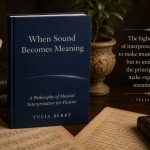
Drawing upon years of performance, teaching, and philosophical inquiry, the article introduces the central ideas behind her book When Sound Becomes Meaning. Rather than treating interpretation as an instinctive or purely personal response, Berry presents it as a conscious and structured artistic process grounded in musical architecture, rhetorical thinking, intention, and responsibility.
Addressing performers, teachers, and advanced students, the essay invites readers to consider how sound, structure, silence, historical awareness, and artistic imagination may align to reveal the deeper meaning contained within a musical work.
The Ritual Voice of the Flute: André Jolivet’s Cinq Incantations
By Yulia Berry · United States
This in-depth study examines André Jolivet’s Cinq Incantations, one of the most significant works in the twentieth-century repertoire for solo flute. The article places the composition within the broader philosophical and historical context of Jolivet’s artistic vision and his belief in music’s ancient ceremonial power.
Through a discussion of the five movements and their symbolic meanings, the article reveals how Jolivet transforms the flute into a ritual voice capable of invocation, meditation, lament, celebration, and dramatic spiritual expression. Repetition, breath, rhythm, silence, and timbral intensity become elements of a musical language that reaches beyond conventional concert performance.
By connecting structure, cultural influences, and interpretive insight, the study offers performers a deeper understanding of the work’s ceremonial character and its lasting importance within modern flute literature.
BETA Quartet Releases Anthems of Dialogue
By Flute Almanac
This news feature presents Anthems of Dialogue, a new album by the contemporary ensemble BETA Quartet. The recording brings together works by living composers whose music explores communication, social reflection, human connection, and cultural exchange through the distinctive medium of the flute quartet.
Known for its commitment to commissioning new music and collaborating closely with composers, BETA Quartet approaches the flute ensemble as a space for conversation. The works featured on the album respond to contemporary realities while demonstrating the broad expressive range of four flutes in dialogue.
The release forms part of the ensemble’s wider Anthems of Dialogue initiative, which seeks to expand the contemporary flute-quartet repertoire while encouraging meaningful artistic exchange among performers, composers, and audiences.
Exploring the Art of Piccolo Playing: The Work of Hanna Turonek
By Flute Almanac
This article introduces the pedagogical and artistic work of Polish piccolo specialist Hanna Turonek, with particular attention to her publications Mastering the Piccolo and 42 Etudes for Piccolo Flute, as well as the recording Piccolo Musical Joke.
Through a detailed discussion of selected studies, the article examines Turonek’s approach to the specialized challenges of piccolo playing, including articulation control, tone stability, upper-register security, technical agility, and expressive flexibility.
The etudes combine focused technical work with vivid musical characterization, encouraging players to develop imagination alongside precision. The accompanying recording demonstrates how technical foundations may be transformed into engaging musical storytelling, making the materials valuable resources for teachers, students, and professional performers.
A Global Conversation About the Flute
The Spring 2026 edition demonstrates the remarkable breadth of the modern flute world. Its contributors move between historical scholarship and contemporary experimentation, physiological research and philosophical reflection, individual artistry and large-scale community projects.
Together, these articles present the flute not only as an instrument of performance, but also as a vehicle for memory, cultural identity, scientific inquiry, education, dialogue, and human expression. The edition honors the instrument’s historical inheritance while remaining fully engaged with the questions facing musicians in the present.
With the launch of Young Flutist Spotlight and the participation of authors from seven countries, this issue reaffirms Flute Almanac’s commitment to connecting the international flute community while documenting both the heritage and the future of the instrument.
With Gratitude to Our Contributors and Readers
We extend our sincere gratitude to every contributor who made this edition possible. The generosity of authors who share their research, knowledge, experience, artistic reflections, and discoveries allows Flute Almanac to continue growing as a meaningful international resource.
We are equally grateful to our readers around the world. Your curiosity, engagement, and support continue to inspire the development of the publication and the educational and cultural initiatives that have grown from it.
Preserving the Spring 2026 Edition
This page preserves an overview of the Spring 2026 edition of Flute Almanac, originally published on March 15, 2026. Through this archive, the research, ideas, performances, traditions, and individual voices gathered in the edition remain part of a lasting record of international flute culture.
Continue Exploring
Explore the Complete Flute Almanac Ecosystem
Continue your journey through a growing international educational ecosystem devoted to flute performance, history, pedagogy, research, craftsmanship, professional visibility, artistic excellence, and meaningful thought.