New from Flute Almanac Editions
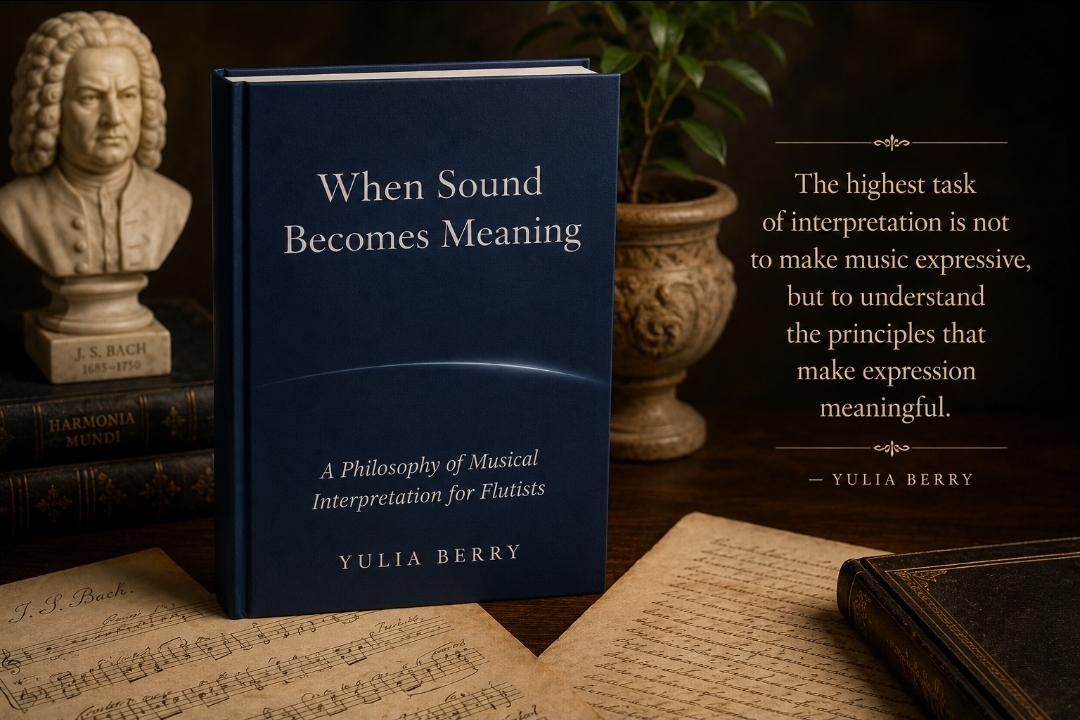
When Sound Becomes Meaning
A Philosophy of Musical Interpretation for Flutists
by Yulia Berry, DMA
Musical interpretation is often discussed in the language of expression: sensitivity, emotion, freedom, individuality, and beauty. These qualities are essential, yet they do not explain how a performance acquires coherence, why one interpretation appears inevitable while another remains merely attractive, or how a musician learns to distinguish expressive conviction from personal impulse.
When Sound Becomes Meaning, a new book by flutist and educator Yulia Berry, begins with this unresolved problem. It asks what occurs between the production of a sound and the communication of a musical idea. How does a sequence of notes become a phrase? How does a phrase acquire direction? What allows rhythm, harmony, breath, articulation, and silence to participate in a single intelligible thought?
Written specifically for flutists while addressing questions relevant to all serious performers, the book presents interpretation as a discipline of attention. Its concern is not with prescribing one correct manner of playing, but with developing the intellectual and perceptual conditions through which artistic decisions become informed, coherent, and responsible.
“The highest task of interpretation is not to make music expressive, but to understand the principles that make expression meaningful.”
— Yulia Berry
Interpretation Beyond Intuition
Performers are frequently encouraged to be expressive, yet expression itself is rarely defined with precision. It may refer to dynamic contrast, flexibility of tempo, intensity of tone, personal feeling, or the visible projection of emotion. Without a structural foundation, however, these elements can remain disconnected from the work they are intended to illuminate.
Berry argues that musical meaning does not arise from emotional emphasis alone. It emerges through relationships: between tension and release, motion and arrival, expectation and interruption, sound and silence. The performer’s task is therefore not simply to decorate the score with feeling, but to perceive and communicate the forces already active within it.
This approach does not diminish imagination. On the contrary, it gives imagination a more substantial role. Artistic freedom becomes more persuasive when it grows from close listening, formal understanding, stylistic awareness, and the capacity to recognize the hierarchy of musical events.
Why the Flute Requires This Conversation
The flute presents a particular interpretive paradox. Its sound may appear immediate and effortless, yet every phrase depends upon a complex coordination of breath, resistance, articulation, resonance, timing, and physical release. Because the tone is formed through an airstream rather than through direct contact with a string, reed, or key mechanism, musical intention must be shaped through exceptionally refined control of breath, embouchure, and gesture.
In this context, technical decisions are never entirely technical. The placement of a breath alters syntax. The weight of an articulation changes rhetoric. The timing of a diminuendo affects musical expectation. Tone color may clarify or obscure formal direction. The book examines these decisions not as isolated techniques, but as elements of musical thought.
Questions at the Center of the Book
How does a performer identify the central direction of a phrase?
When does expressive freedom strengthen the structure, and when does it conceal it?
What is the relationship between breath, syntax, and musical time?
How can teachers speak about interpretation without reducing it to imitation?
What responsibilities does a performer have toward the score, the composer, the audience, and personal artistic judgment?
Not a Method Book
When Sound Becomes Meaning does not offer a sequence of technical exercises, a system of interpretive rules, or a catalogue of expressive solutions. It is concerned with the principles from which such choices should arise.
Its chapters move across acoustics, musical rhetoric, formal perception, attention, memory, imagination, silence, responsibility, and the nature of artistic creation. These subjects are treated in clear language, without assuming that philosophical seriousness must depend upon abstraction or obscurity.
The result is a book intended to be read slowly and returned to repeatedly: during repertoire study, lesson preparation, artistic uncertainty, and the continuing formation of one’s own interpretive values.
A Book for Performers and Teachers
The book will be especially relevant to advanced students, professional performers, university-level teachers, and musicians who have reached a stage at which technical competence no longer answers the most important artistic questions.
It also offers teachers a vocabulary for discussing interpretation with greater precision. Rather than asking students simply to “play more expressively,” it encourages attention to musical cause and consequence: where energy originates, how it is sustained, what changes its direction, and why a phrase reaches its destination.
The Author
Yulia Berry, DMA
Yulia Berry is a flutist, educator, editor, and founder of several international initiatives devoted to flute performance, education, research, cultural preservation, and professional recognition.
Her approach has been shaped by more than three decades of performing and teaching, during which questions of interpretation repeatedly emerged beneath questions of technique. Why do some technically accomplished performances remain unconvincing? Why can a modest musical gesture carry greater force than a dramatic one? How can a teacher help a student develop judgment rather than dependence?
When Sound Becomes Meaning gathers these questions into a single philosophical study and places them within a broader examination of what it means to interpret music responsibly.
The First Edition
The first edition has been released digitally by Flute Almanac Editions. The digital format preserves the full structure of the work while making it immediately accessible to readers, performers, and teachers internationally.
The publication marks the beginning of a larger body of writing devoted to musical meaning, interpretation, artistic responsibility, and the relationship between sound and human understanding.
When Playing Becomes Interpretation
The central claim of When Sound Becomes Meaning is both simple and demanding: a musical work does not become meaningful merely because it is played accurately or sincerely. Meaning must be discovered, organized, and carried through time.
For the performer, this requires more than skill. It requires judgment, attentiveness, humility, imagination, and the willingness to listen beyond the immediate beauty of sound toward the deeper order that gives that beauty its purpose.
Published by Flute Almanac Editions
When Sound Becomes Meaning
A Philosophy of Musical Interpretation for Flutists
$29.95
Digital edition
Explore the Book