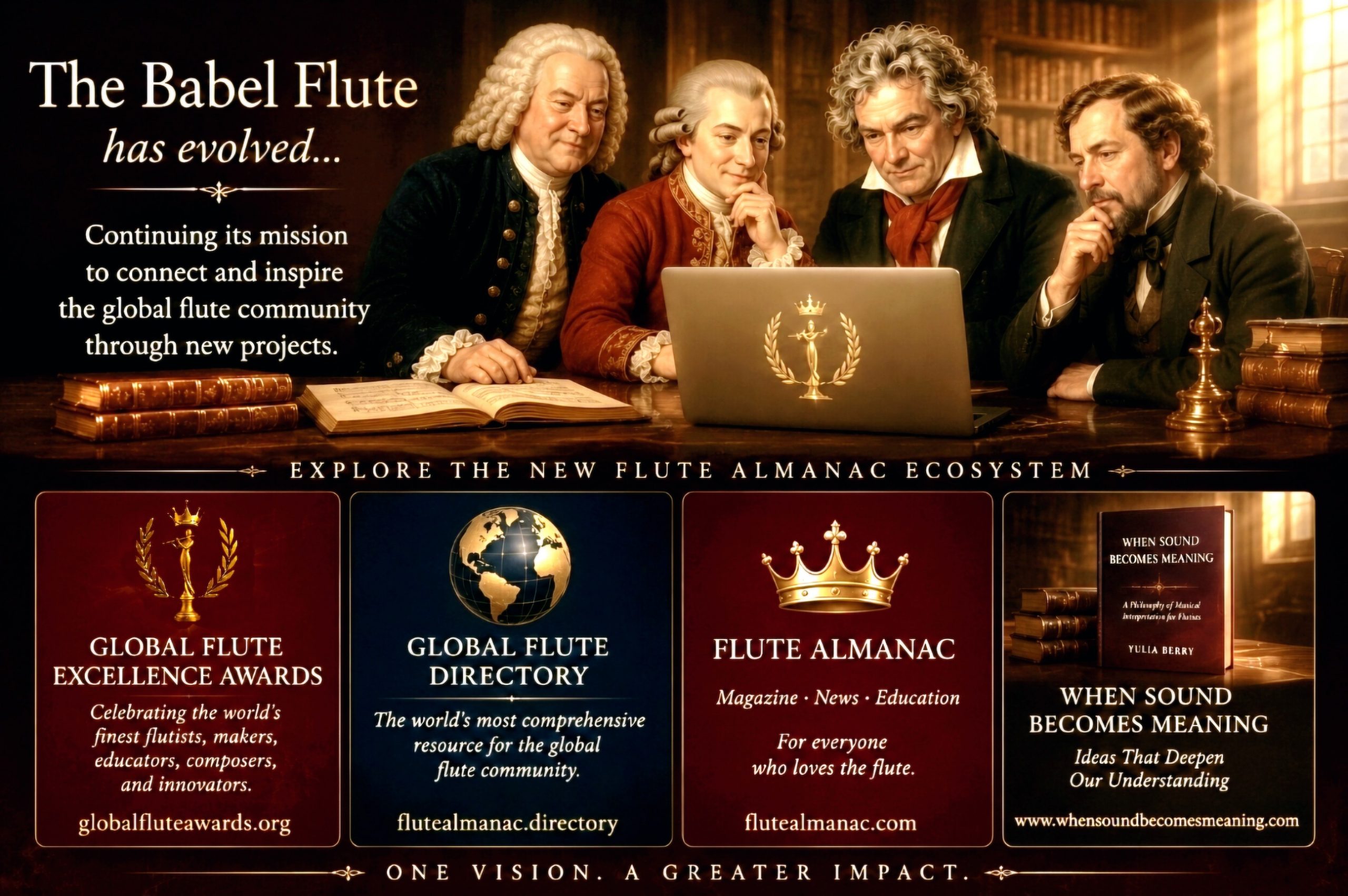
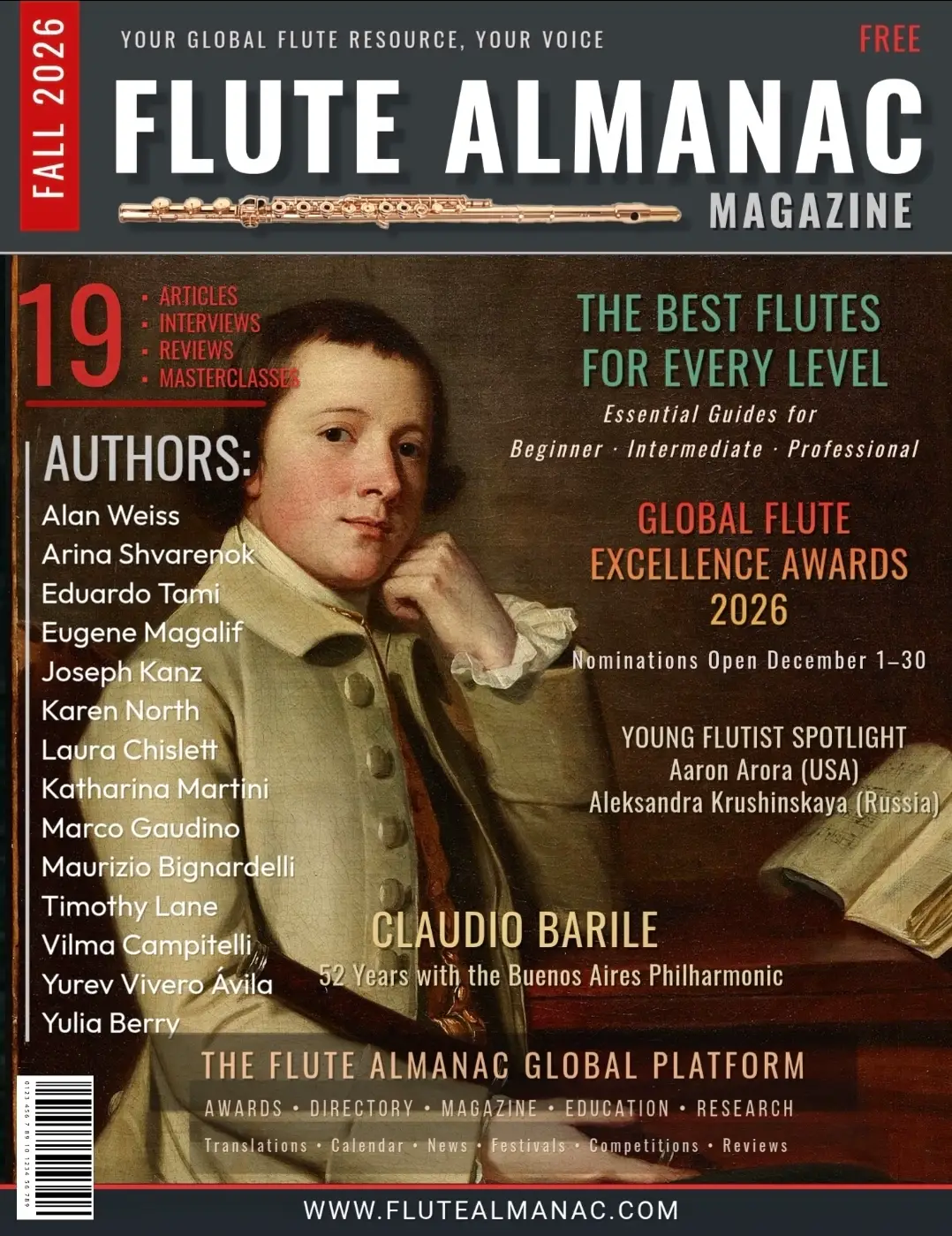
From The Babel Flute to Flute Almanac: Discover the Fall 2026 Edition
The international publishing journey that began with The Babel Flute continues to grow through Flute Almanac.
Over the years, The Babel Flute brought together performers, teachers, composers, researchers, and flute enthusiasts from many countries, languages, and musical traditions. Its central idea was simple but important: the flute world becomes richer when knowledge and experience are shared across borders.
Flute Almanac carries that vision forward through an expanded global platform encompassing an international magazine, news and reviews, educational resources, historical research, professional recognition, opportunities for young musicians, and a worldwide flute directory.
The new Fall 2026 Edition of Flute Almanac represents another major step in that development.
Bringing together 19 articles, features, and educational masterclasses by 14 authors from seven countries, the edition travels from nineteenth-century Naples to contemporary Cuba and the United States; from Baroque performance practice to artificial intelligence; and from the physical foundations of flute playing to the emotional and professional challenges musicians face in the digital age.
The contributing authors represent Argentina, Australia, Germany, Italy, Mexico, Russia, and the United States. Their work appears in several original languages and can be read worldwide through instant translation.
One Flute World, Many Voices
The Fall Edition reflects a principle that has guided both The Babel Flute and Flute Almanac: the flute world has no single geographical or cultural center.
Its knowledge is carried by performers, teachers, composers, scholars, instrument makers, students, publishers, and independent researchers working across different traditions and generations. Some preserve musical history; others develop new methods, introduce unfamiliar repertoire, examine contemporary professional life, or create opportunities for the next generation.
By bringing these perspectives together and making them freely accessible, Flute Almanac continues building an international space for serious writing, artistic discovery, education, and exchange.
The publication has also reached a new stage of global visibility. During its latest 30-day reporting period, the website recorded 8.23 million requests, an increase of approximately 63 percent from the 5.04 million recorded only two weeks earlier. By July 2026, its content had reached readers in 252 countries and territories, while numerous articles have appeared in Google Discover, introducing the publication to audiences beyond those already searching for flute-related information.
Behind these numbers is a specialized international readership of performers, teachers, students, composers, researchers, flute makers, publishers, institutions, and music lovers.
Claudio Barile: Celebrating an Extraordinary Career
At the center of the Fall Edition is a major feature honoring Argentine flutist Claudio Barile, who has concluded an extraordinary 52-year tenure at Teatro Colón.
Barile joined the Buenos Aires Philharmonic in 1974 and served as its Principal Flute from 1984. His career, however, extends far beyond his orchestral position. It encompasses concerto appearances, chamber music, historical instruments, recordings, international performances, and decades of teaching.
The feature also explores his personal connection with Astor Piazzolla and the firsthand musical understanding that informed his interpretations and recordings of Piazzolla’s flute music.
Although Barile has retired from the orchestra, he has not retired from music. He intends to continue practicing, teaching, studying, and performing. His final concert therefore marks the conclusion of an exceptional orchestral chapter rather than a farewell to artistic life.
With his energy, individuality, and unmistakable stage presence, Barile has earned an affectionate description that captures something essential about his personality: “the Mick Jagger of the flute.”
History Recovered and Reconsidered
Several articles in the edition preserve important chapters of flute history.
American flutist Alan Weiss offers an intimate portrait of Boston Symphony Orchestra flutist and influential teacher Phillip Kaplan. Drawing upon personal memories and archival materials, Weiss explores Kaplan’s studies with Georges Laurent and Georges Barrère, his appointment to the Boston Symphony Orchestra by Serge Koussevitzky, his relationships with leading musicians and flute makers, and his demanding but deeply constructive approach to teaching.
Italian flutist and musicologist Maurizio Bignardelli contributes a two-part exploration of nineteenth-century flute culture in Naples. The first article reconstructs the life of Teofilo Bucher, the Alsatian virtuoso who became Principal Flute of the Teatro di San Carlo. The second examines Pasquale Sogner’s solos for unaccompanied flute and the flourishing publishing market that supplied Naples’s aristocratic amateur musicians with arrangements of popular operatic melodies.
In Germany, musician and collector Joseph Kanz continues his investigation of historical flute systems with My Encounter with an English Hybrid Flute. Beginning with the restoration of an 1882 Radcliff-system flute, he explores an ingenious design that combined aspects of traditional fingering with many of the acoustic and intonational advantages associated with the Boehm system.
Mexican flutist Yurev Vivero Ávila brings the first stage of his long scholarly journey to a conclusion in From Study to Publication: Translating Hotteterre for a New Generation. His work on a critical Spanish-language edition of Hotteterre’s Principles of the Flute and The Art of Preluding will make these foundational Baroque treatises more accessible to Spanish-speaking musicians.
Contemporary Music, Identity, and Interpretation
The edition also explores how music carries personal, cultural, and historical identity.
Argentine flutist and composer Eduardo Tami examines phrasing and expressive practice in tango. Rather than prescribing a single “authentic” interpretation, he encourages musicians to understand the social world, language, movement, and musical traditions from which tango emerged—and then allow that knowledge to pass through their own artistic imaginations.
Vilma Campitelli presents an extensive study of Pulitzer Prize–winning Cuban-American composer Tania León. The article traces León’s journey from Havana to the United States and considers how Cuban and Afro-Caribbean traditions, jazz, gospel, movement, memory, and contemporary compositional techniques converge in her work. A substantial examination of her flute repertoire reveals the instrument as a vehicle for rhythm, breath, identity, and cultural memory.
Australian educator and publisher Karen North argues that developing musicians also deserve meaningful contemporary repertoire. In New Music for New Players, she explains why accessibility should never be confused with artistic emptiness. Student and amateur flutists need music that respects their technical level while still treating them as genuine creative artists.
Composer Eugene Magalif reflects on performances of his works across three countries in My Flute Music in Peru, Greece, and Turkey. His account demonstrates how music moves beyond the composer through the commitment of performers, ensembles, teachers, and audiences who welcome it into their own artistic communities.
The Musician’s Body, Mind, and Sense of Time
Several contributors turn their attention to the inner experience of performing.
In In Resonance with Yourself, German flutist Katharina Martini presents her Resonating Body Method, connecting physical freedom, mental well-being, instrumental technique, and stage performance. She considers how pain, fear, muscular tension, and harsh self-judgment can reinforce one another—and how awareness, patient work, and achievable goals can support healthier and more expressive music-making.
Timothy Lane concludes his pedagogical series with The Rule of Mechanical Separation — Part 2. His exercises isolate the individual movements involved in embouchure and articulation before gradually reintegrating them, helping flutists develop greater flexibility, coordination, and physical awareness.
Marco Gaudino investigates why two works played at similar metronome markings can feel entirely different in The Mystery of Saint-Saëns’s Aviary: The Perception of Time. Comparing Saint-Saëns’s Volière with Bach’s Badinerie, he examines how articulation, note density, breathing, gesture, motor demands, and musical imagery influence a performer’s perception of speed and difficulty.
Russian researcher Arina Shvarenok addresses another urgent dimension of musical life in The Devaluation of Musicians’ Work: Competing with Emptiness. She considers how years of artistic development are compressed into seconds of online content and how views, likes, constant visibility, and expectations of unpaid digital labor can distort musicians’ understanding of professional worth.
Australian flutist Laura Chislett offers a different response to contemporary uncertainty in Playing for Hope. Through the work of the Armistice Flute Quintet, she presents music as an act of communication, cooperation, friendship, and hope. The ensemble’s concerts support humanitarian organizations providing food and clean water in areas affected by conflict.
Education in the Age of Artificial Intelligence
In If AI Can Give Us Every Answer, What Becomes of Education?, Yulia Berry examines what education must become when information is available almost instantly.
The essay distinguishes among four stages of learning: information, knowledge, understanding, and meaning. It considers the many ways human beings learn—through imitation, repetition, experience, failure, dialogue, relationships, reflection, and creation—and contrasts computational “deep learning” with the human process through which knowledge gradually transforms perception and judgment.
If artificial intelligence can provide answers, education must place still greater emphasis on teaching people how to question, evaluate, imagine, choose, and accept responsibility for their choices.
For musicians, the purpose remains deeply human: allowing technique to become expression, knowledge to become understanding, and sound to become meaning.
Creating Space for Young Musicians
The Fall Edition marks an important stage in the development of Flute Almanac’s resources for younger flutists.
Young Flutist Spotlight is an international, non-competitive recognition program for musicians between the ages of 8 and 18. Rather than ranking students or defining promise entirely through prizes, it considers each young musician’s dedication, perseverance, artistic growth, passion, personal story, achievements, and potential.
The first four Selected Artists are Chiara Lapetina of Italy, Layla Kretchmer and Aaron Arora of the United States, and Aleksandra Krushinskaya of Russia. Their five teachers are also recognized for the essential role mentorship plays in young musicians’ development.
At the end of the year, all Selected Artists and their recognized teachers will enter the inaugural Young Flutist Spotlight Honor Roll.
The educational comic Superpan also returns with two new episodes exploring respect, listening, patience, and human connection.
A new companion series, Prof. Eolo: Flute Lessons, introduces practical principles of breathing, airflow, tone production, and flute technique through concise visual stories. Together, these projects demonstrate that serious musical education can remain accurate, imaginative, encouraging, and enjoyable.
A Growing International Platform
Beyond the quarterly magazine, the larger Flute Almanac platform continues to expand.
The Global Flute Directory is approaching 400 listings, connecting readers with performers, teachers, makers, repair specialists, publishers, ensembles, organizations, competitions, festivals, and other flute-related resources.
The Global Flute Excellence Awards will return for their third annual cycle, with nominations open from December 1 through December 30, 2026. With Sir James and Lady Jeanne Galway serving as Honorary Chairs, the Awards recognize excellence in performance, teaching, composition, flute making, innovation, advocacy, ensemble work, emerging artistry, inspirational leadership, and lifetime contribution.
The Toward Meaning essay collection continues exploring the relationships among music, philosophy, science, education, creativity, interpretation, and human experience.
Together with the magazine, news portal, reviews, international calendar, educational guides, Young Flutist Spotlight, historical archives, and specialized resources, these projects form an interconnected global platform devoted to informing, recognizing, educating, preserving, and connecting the flute world.
Explore the Fall 2026 Edition
We warmly invite readers of The Babel Flute to discover the complete Fall 2026 Edition of Flute Almanac.
This new edition continues a conversation that began years ago: a conversation among countries, languages, generations, traditions, and individual musical lives.
We offer our deepest thanks to every author, performer, teacher, composer, researcher, student, family, photographer, and institution whose knowledge and generosity made the edition possible.
Above all, we thank our readers. Your interest confirms that substantial writing, artistic memory, thoughtful education, and meaningful international dialogue continue to matter.
Contribute to the Winter Edition
Flute Almanac is now accepting proposals for its Winter Edition, which will be published on December 15, 2026.
Flutists, teachers, composers, researchers, makers, historians, and writers are invited to propose original articles on flute history, pedagogy, repertoire, performance practice, interpretation, physiology, instrument making, innovation, cultural perspectives, and the changing professional lives of musicians.
Authors may write in their native languages. Through Flute Almanac’s instant translation system, their work can become accessible to readers worldwide.
The final submission deadline is November 30, although early proposals are strongly encouraged. Prospective contributors should consult the complete Flute Almanac Submission Guidelines before submitting their work.
We look forward to continuing the international conversation—and to discovering the histories, experiences, research, and ideas that will shape its next chapter.


